

I’m going to rewrite my book entitled Somatic Milonguero: Movement Awareness for Close Embrace Social Tango Dancing.
It’s too academic and scattered.
Also, I want to move away from focusing on history and culture, and instead focus purely on movement.
My idea was to load it with even more information by adding stuff on tango music and DJing.
Big mistake.
The main issue really, at least to start off with, is the movement.
Why?
Movement is something that is learned naturally.
Dancing movement is something that is spontaneous and natural.
It can be adapted to specific styles of music (waltz, samba, tango) and social contexts (carnival, partner social dancing, etc.).
But at the basis it’s the same body and the same movement.
Not everyone develops their movement skills fully because of civilisation.
Especially, walking on flat hard surfaces and sitting for hours in the classroom.
This is not the natural environment in which our movement evolved.
Civilization means that we fail to fully develop all the neural connections.
We become stiff.
Then the Western objective scientific rationality makes things even worse.
We started to conceive of the body mechanically and 3 dimensionally.
We developed dances like the classical ballet that use the body in a way that looks amazing but is completely unnatural.
Then social partner dancing took on that schema in the 20th century to arrive at the grotesque ‘sports dance’ idea.
When tango was ready for global commercialization the whole conceptual scheme of the dancing studios with wall to wall mirrors was in place to reconstruct it.
You break down the movements, make them athletic and mechanical, and teach them by rote and repetition.
If people find it difficult you tell them that it’s a difficult dance and needs a lot of technique workshops.
The alternative conception of the body and of movement is found in Eastern martial arts practices like Tai Chi or Aikido.
These practices conceive of the body and movement in terms of a kind of energy called Ki or Chi.
This energy organizes movement in a particular way.
It begins at the centre of the pelvis and emanates out through the spine, shoulder, the underarm and the hands.
Steve Paxton, a renowned teacher of movement improvisation in the US, argues that you can feel this energy in the handshake.
You feel it just before grasping the other person’s hand.
This action organizes the body (the spine and the pelvis) in a particular way around this point of contact between the hands.
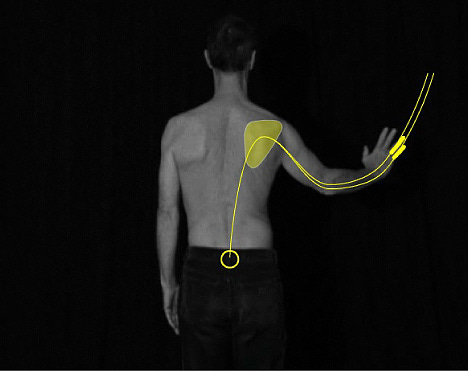
The push-pull is actually at the underside of the hand and the pinky finger.
This part of the hand actually connects through the underarm and the shoulder toward the centre at the pelvis.
It’s a very connected and integrated position.
This mechanism is not the disjointed, ‘mechanical’, image of the body that you find in contemporary Western culture.
Western culture conceives of the body in terms of conjoined units that can be trained in separation from each other.
This is the conception underlying the ‘steps’ ‘figures’ and ‘technique’ scheme.
Arms begin at the shoulders, and legs begin at the hips.
You need to learn ‘separation’.
Etc etc.
The nearest equivalent of the Eastern conception is something like the Brazilian Capoeira, esp. Capoeira Angola.
But it’s also implicit in the convivial ‘tango milonguero’ dancing at places like Salon Canning Milonga Parakultural.
The problem is, when tango teachers try to analyze it for the purposes of teaching they go to the Western mechanical model.
They talk about ‘axis’ and ‘leaning’ as if we’re doing physics.
There are endless debates whether you should have your own axis or not.
These debates will be endless because they are framed in the wrong understanding of the body and movement.
The concept of Ki or Chi is part of the training in practices like Tai Chi and Aikido.
This concept is not ‘mystical’.
It just doesn’t fit into the Western objective scientific view of the human anatomy and movement.
But there’s absolutely no reason why it cannot form the basis for movement training for tango.
While my interest is tango milonguero, these are universal systems of the body that do not differentiate between dances or movement practices.
Either you’re using your body in a way that is natural or not.
Still, I don’t expect that the performers and teachers will find it interesting as it doesn’t really serve their commercial agenda.
There’s much money to be made, and attention harvested, providing eye catching floor shows, and selling ‘technique correction’ workshops.
The concept of Ki or Chi is fundamental to the training in Contact Improvisation (CI), which was created by Paxton to transfer this knowledge to Western movement practices.
It’s unfortunate that the teachers of CI often do not know that this, and don’t transfer this knowledge to their students.
My argument is that until the concept of Ki or Chi becomes part of tango teaching, in particular the teaching of tango milonguero, the practice cannot progress beyond its current state of commercialism, commodification and general dissatisfaction.
I agree, to achieve the “song” (relaxation) is much more than just mechanical technique