

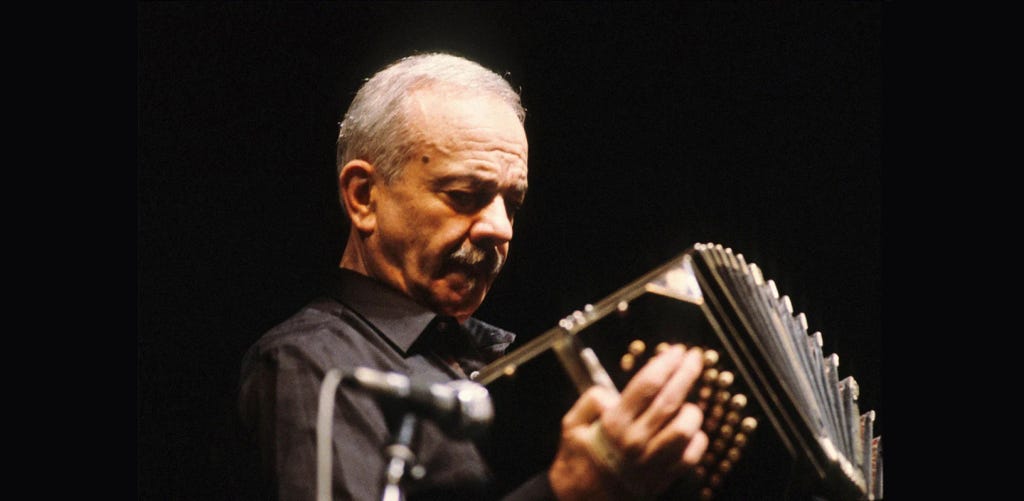
Recently I’ve been immersed in the music of Astor Piazzolla. I’ve been working on some Piazzolla pieces for solo guitar, creating arrangements for both, my classical and electric instruments. Also, I’ve had a chance to attend a couple of ensemble performances of his music.
What struck me about the renditions of this music that you see in performances on the internet, as well as in live performances and also in many written arrangements, is that they don’t sound much like Piazzolla. They have their Piazzolla moments, but for the most part they do little more than replicate a lot of the ‘thumping’ stuff that’s become associated with this music.
Working on arrangements, however, I started to realise that the embellishments that you typically see do little more than cover up shortcomings in the harmonic interpretation of the music.
A composition either works or it doesn’t. A well composed and arranged piece doesn’t need these embellishments which, lacking harmonic interest, just become gimmicky, like noises made by slapping the piano or bandoneon, or by violinist scraping the strings on the far side of the bridge.
Similarly, guitar arrangements that follow the melody but fail to understand the type of harmony, that is, the type of chord, that gives it the unique Piazzolla-esque feel or vibe, force the player into virtuosic speeds and thumping of various sorts to mask the lack of harmonic interest.
There is nothing wrong with changes in ‘dynamics’, that is, changing the speed, loudness, rhythm, etc. to sustain interest. But the harmony needs to be there to provide the meat for the garnishes. Otherwise it’s all fluff and vaporware. You see the instruments huffing and puffing but there’s no bang for buck.
This lack of understanding of the role of harmony as the bedrock of music that holds everything together underneath the melodic movement and the embellishements, is what seems to drive people to the idea that it is the rhythm that defines this or that music. This idea seems to convince people that if there’s banging and scraping of some sort then this must be great music.
Rhythm or time defines the organisation of the notes in a bar of written melody which also provides a certain sort of pulse. But all that means is that there is a logical requirement for the music to be organised in this or that way, either two, three or four beats to a bar. Other than that, the music can be interpreted, or invites an interpretation, that is more or less rhythmic, and that emphasises some beats over others.
Other than the a priori logical requirement that the notes are organised in one way or another in temporal space for there to be a melody, ie., other than that the melody is just defined as the way that notes are temporally and tonally organised relative to each other, rhythm is often an interpretive choice.
However, what’s happened, is that the extreme harmonic simplification of modern music, basically the total reliance on major, minor and diminished triads, is essentially an impoverishment of music that then needs to be pumped up with some sort of a backbeat and a lot of volume and ‘mastering’ gimmickry.
Tango music is essentially an exploration of a space of harmonic and melodic ideas that overlap with other jazz genres. There’s good evidence that during tango’s development in the early 1900’s composers like Cobian were influenced by classical and jazz, and this can be seen most clearly in the ‘tango romanza’ compositions by the likes of Cobian himself, de Caro, Troilo, etc.
Piazzolla can be viewed as continuing this dialogue with jazz and classical, composing longer pieces that employ certain sorts of jazz and classical harmonic-melodic ideas that can be traced all the way back to romanticist composers like Frederick Chopin. Another example is Antonio Carlos Jobim, the strong association of Bossa Nova with a rhythm notwithstanding, whose compositions are really defined by a type of harmonic-melodic movement concept that traces back to Chopin.
What that means for the informed listener and musician is that getting ‘bang for buck’ musically, getting real musical satisfaction, requires seeing (or rather, hearing) beyond the gimmicks and the garnishes to the meat (or lack thereof) of what makes the music work. This requires harmonic understanding and education among the listening public as well as the musicians and arrangers.