

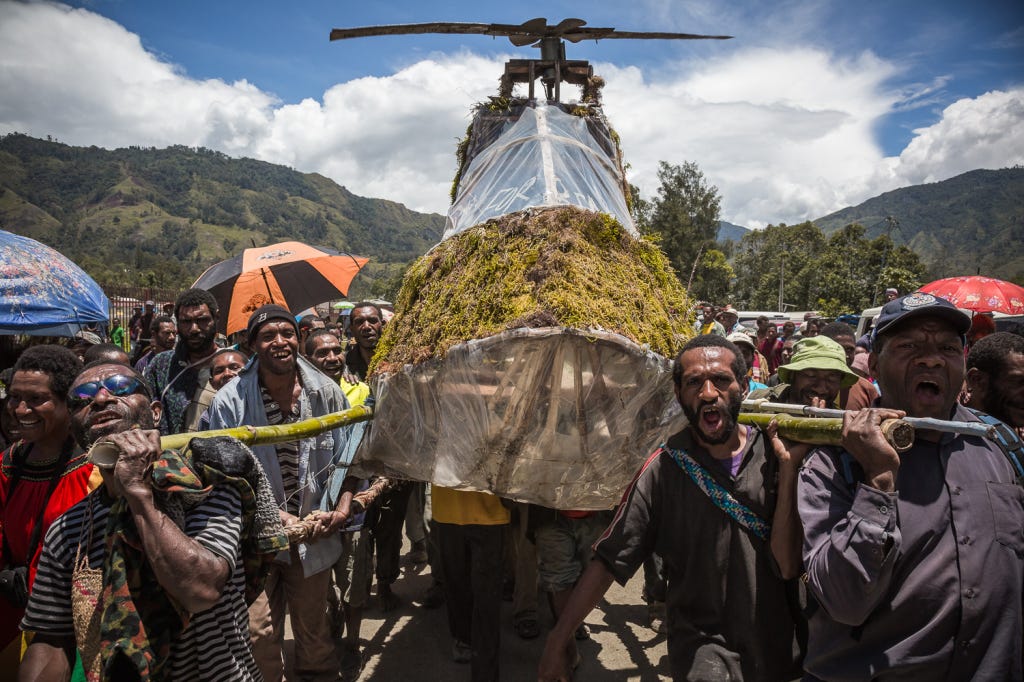
The term “cargo cult” describes a phenomenon observed among indigenous Melanesian populations, particularly after encountering Western goods, technology, and practices. During WWII, these islanders saw military forces arriving with abundant supplies, or “cargo,” which they believed to be gifts from the gods. When the war ended and the cargo flow stopped, some communities ritualistically mimicked the activities of soldiers—building imitation airstrips, radios, or control towers—hoping to attract more supplies.
The cargo cult is a misunderstanding of how the ‘cargo’ is produced. The cultists see the end product but don’t understand the process through which the product arrived. This can apparently also happen in developed countries, as when a government minister in South Africa stated that farmers are not needed to produce food because supermarket chains provide it. Presumably he believes that the way to provide more food all that is needed is to build more supermarkets.

When you look at dancing classes the students are laser focused on the demonstrations and explanation of the teachers and really want to ‘get it’. What you’re seeing is a cargo cult. It’s really no different from the obsession among many Japanese students of English with studying grammar. They study it as if through a microscope failing to see the whole thing. They believe, it seems, that learning English requires memorising the grammar book.
I recently went to a practica and saw the end of a tango lesson in which the students were laser focused on the explanation and correction, at the end of which they packed up and left, or if they stayed it was to practice their lesson routines. They assume that going through this ritual will get them to tango, and it never does.
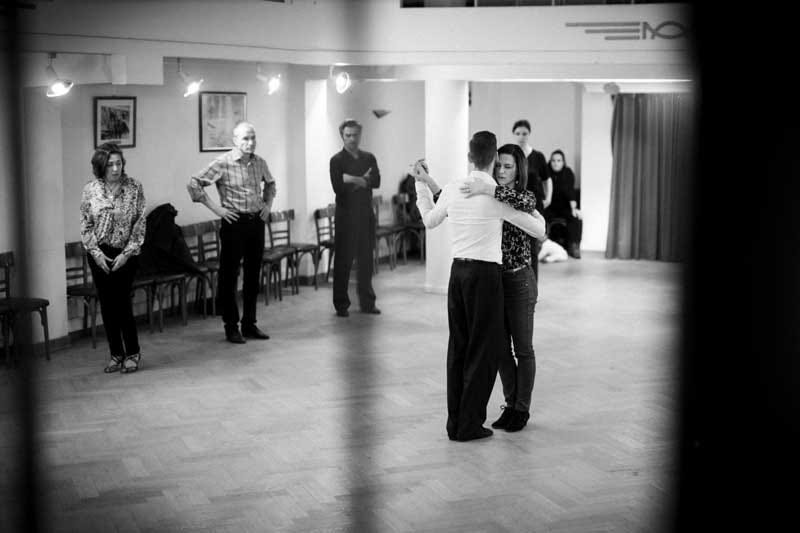
In all their studying and practicing they never dance, just as the Japanese students of English grammar never actually use English for any real communicative purpose, even to watch an English language program. You try to have a conversation with the Japanese and they just go through the motions of practicing conversation, and you try to dance with these tango students and they go through the motions of practicing their workshop material.
Just as English speakers have little tolerance for boring conversation, so tango dancers have little tolerance for practicing tango with these students. Just as the idea of using the language instead of always studying it often doesn’t enter the grammar student’s consciousness, so the idea of just dancing seems not to enter the consciousness of the tango student.
What is lacking is the understanding of where dancing and dance culture comes from, which is music. The Western nations have been so effective at destroying their own cultural heritage over the past 100 years and replacing it with sports and exercises of various kinds, typically against the rhythmic background of modern music, that dancing has essentially became a sport. It’s become attached to some mechanical and completely unnatural movements essentially no different from what you do in a gym stepping class.
The idea of dancing technique is particularly cultish. Since the steps are unnatural and not easily executed with a partner, there’s need for a lot of explanation of technique as the necessary ritual to attain naturalness and enjoyment. Despite regular prayer and sacrifice neither naturalness nor enjoyment arrive. The students persist nonetheless, 18 months on average, by which time the Voodoo priests get a new batch of cult followers to exploit.
The concept of the dancing studio is completely a cargo cult idea. A room with a mirror and a source of music was required for stage dances, so the wall-to-wall mirror came to predominate as the marker of a dancing space. The problem is that a large glass surface completely destroys the acoustic experience (more on this here) or any naturalness in the sense of visual/acoustic space, and draws attention away from inner sensations that provide necessary feedback for partner dancing. There is nothing natural, organic or conducive to satisfactory social dancing in any of this.
Another one is the confusion of natural sound with the equipment of the DJ. Natural sound originates in instruments and resonates through the space to create a pleasant acoustic experience that motivates social dancing. However, most music has been produced in the last few decades through some sort of a DJ-ing gear and so producing tango music became associated with equipment designed for the reproduction of modern electronic music artificially produced using computer software.
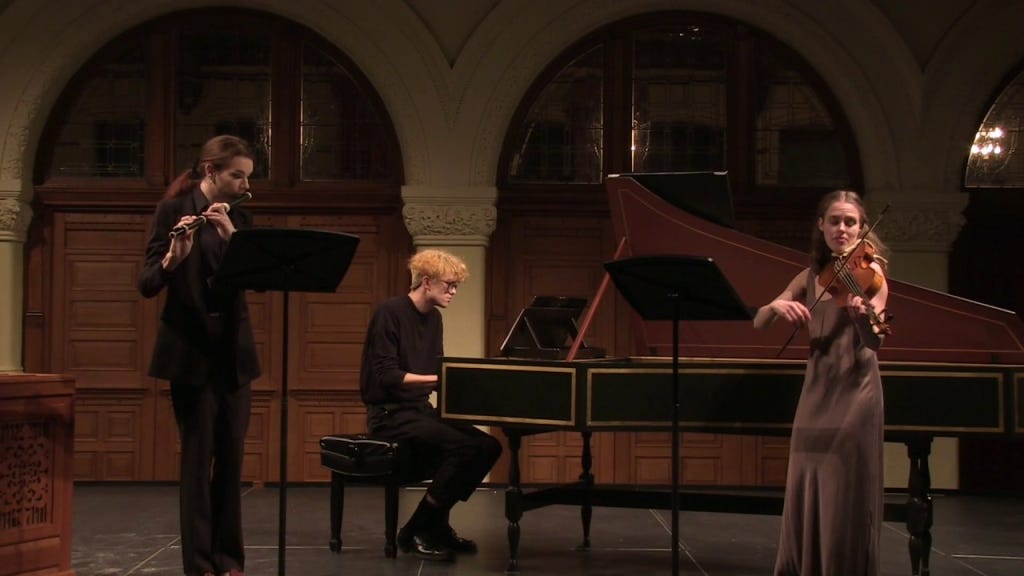
Electronic music has virtually nothing in common with classical music like tango played for the most part on acoustic instruments. But when we see people staring at DJ-ing software on their laptop and manipulating EQ knobs on the mixer board we assume that we must be getting great tango music. Total cargo cult.
Natural dancing, in its basic form, is a movement that is most immediately associated with the slow dance, which is an embracing couple swaying rhythmically side to side and around. Whether it’s waltz, salsa, milonga or tango, it’s all slow dance expanded in various ways. You can’t dance naturally without this kind of movement as the basis of social partner dancing.
The movement of all studio ballroom dancing classes is unnatural insofar as the teachers prohibit, discourage or ignore this basic movement. On the other hand, once this movement is picked up you can learn all the ways of extending it in pretty much a handful of lessons (which is probably why the don’t teach it, not good for business).

The difference between tango and other dancing like milonga or salsa is that the latter mostly involve this movement back and forth whereas the tango cadence suggests a continual flow several steps before ‘returning’. Without the natural sense of swaying and turning, the dancing is feels disorienting and mechanical, with no natural beginning, ending or flow.
Other than that, it’s all about the music. But if you treat the music as mere rhythmic background emanating out of someone’s DJ gear, without giving it any more attention than that, and if you fail to start out with the pendular and rotational movement of the slow dance, then you’re basically participating in a cargo cult, or if you teach that way then you’re the leader of a cargo cult, which might be where you want to be. I feel that tango attracts aspiring cult leaders as ‘teachers’ and so what we get is a global tango cargo cult.