

First, some definitions:
Corporatism is a political and economic system in which various sectors of society, such as business, labor, and other interest groups, are integrated into the government to participate in policymaking and regulation. Instead of relying on individual or free-market interactions, corporatism emphasizes collaboration and structured relationships among groups to ensure that policies reflect the interests of society’s different sectors. While corporatism aims for harmony and reduced conflict among competing groups, critics argue it can lead to inefficiency, reduced individual autonomy, and entrenchment of elite interests.
Third spaces are social environments distinct from home (first space) and work (second space) where people can gather, connect, and build community. These spaces include places like coffee shops, parks, libraries, and community centers, where the focus is on social interaction and fostering a sense of belonging. Third spaces are often informal, inclusive, and neutral settings that encourage casual conversation and connections among people from diverse backgrounds. Sociologist Ray Oldenburg, who popularized the concept, emphasized that third spaces play a crucial role in promoting civic engagement, reducing isolation, and strengthening community bonds by providing a relaxed venue for socializing outside of structured, purpose-driven settings. (Source: ChatGPT)
Last night I attended a branch meeting of the New South Wales Libertarian Party to see who these people are. I wasn’t surprised that most of them were basically ex-Liberal Party (the Australian version of British Tories or American GOP) boomers with a background in finance, and everyone was clueless as to what libertarianism actually is. All these people wanted was to get rid of Nimbyism in order to be able to build high rises in what are currently single home burbs.
Now, I don’t have a real problem with medium density urbanism. The problem is that I know exactly what they will build, because you see it everywhere: soulless modernist concrete and glass apartment blocks and big box shopping malls. That is now the cookie cutter modern urban planning.
There was guy from an Argentinian background telling us about his recent trip to Argentina and Milei’s libertarian reforms. Of course I mentioned that I’m interested in tango.
I mentioned that I think tango has a certain political significance for libertarians because it represents a sort of ‘third space’ where people can freely interact which allows for building social capital in a way that is outside of the control of the corporate state. I think that the corporate state has a vested interest commodifying these third spaces and turning them into little more than vacuous consumerism devoid of any real cultural value.
I noticed for example that in communist China all cultural activity is sort of ‘approved astroturf culture’. They build these mass cities full of high rises and then they’ll reserve a large block for a ‘creativity space’ full of ‘creaivity companies’, like some sort of interior design stuff, modernist hipster cafes and art galleries.
All of this seemed pretty cool and hip but after a while I noticed that all of this stuff is completely top-down astroturf and fake state funded pseudo-culture.
It became pretty obvious that none of these cafes or galleries are actual money making businesses and for the most part they stood empty despite large footage filled with arty furniture, fake antiques and retro deco.
The people staffing these establishments did not look like they have any real interest in this stuff as they had a blue collar look about them. It was all obviously nothing more than a background for the obligatory social media selfie for the corporate office workers on their weekend outing.
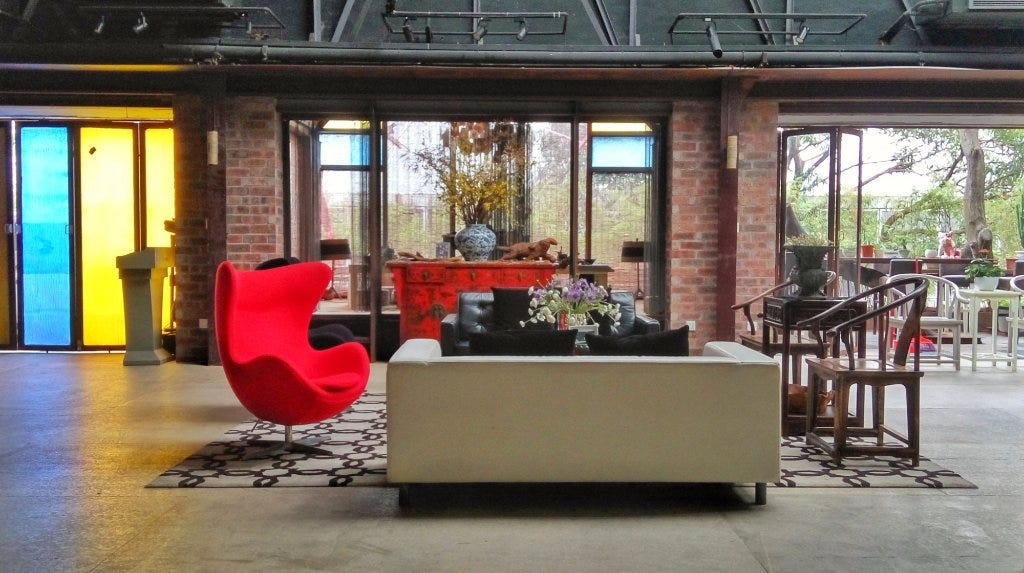
Arty cafe at OCT Loft Creative Culture Park in Shenzhen, China
This is what the centrally planned corporate communism looks like: fake state approved astroturf pseudo-culture. After a while I realised that it’s the same thing with tango in China. I was running some lessons and then one of the women asked us to do a performance at her company.
This actually reminded me of how my first tango teacher go me to perform tango at a singles event in Sydney. The whole thing struck me as really shallow and culturally disinterested. It’s basically the same shallow cynical corporate commodified culture, no different whether it’s corporate communist China or corporate capitalist Australia.
So in the conversation with the Argentinian guy I mentioned that I think that these corporatist governments have a vested interest in commodifying cultural activities like tango, as either therapy or corporate stuff like ‘corporate yoga’, because they want to control so-called third spaces.
When you look at shopping malls, these are essentially turning shopping into a completely boring alienating sterile experience that discourages human interaction. I don’t know but personally I don’t find myself mingling with people at a shopping mall than I do at an outdoor produce market.
And that’s exactly how the corporatist state like it. They pay lip service to ‘community’ all the while they will plonk a big box shopping mall in the middle of your neighbourhood on the grounds that it provides economic growth or whatever.
It’s fairly obvious that the general trend in modern globalised corporate governments is to control third spaces by way of consumerism and state largesse.
Tango is one of those activities that provides for social interaction among strangers in a convivial atmosphere and so the corporate state will view it with suspicion and caution. It’s culturally enriching and so reduces the propensity to engage in pointless conspicuous consumption thus having a negative impact on the all-important GDP number. The bureaucrats ideally want you to commute between home and work, and then if you do anything else it needs to involve consuming meaningless stuff.
If you want ‘culture’, ie., convivial cultural activity, then they want you to apply for state funding so that they will direct it toward therapeutic approved astroturf pseudo-cultural arty stuff that makes them look good and does not inspire you in the direction of building autonomous social capital external to the corporate state slave colony.