

When we study tango music, we tend to focus on the so-called ‘golden era’ or epoca de oro (EdO) recordings of the 1940’s.
However, the 1940’s was already relatively late in the development of tango music.
Some people actually regard the 1910-20’s as the real golden era of tango.
In order to understand what we’re listening to today we need to understand the major shift in the style of performance of tango orchestras in Argentina between the 1920’s and the 1930’s.
Starting around 1935, the approach to performance has changed from the earlier golden era.
These latter recordings are considered to be more suitable for dancing because of their greater energy.
However, this energy, which is due to the increased size of the orchestras, and the approach to performance aimed at creating a bigger sound also seems to render these recordings less approachable for listening.
It may be argued that these tangos are for dancing and not for listening, so why bother discussing that.
However, it’s not clear that music for dancing is not suitable for listening.
Yet we find that there is relatively little listening to tango going on among tango students outside of the classes, practicas and milongas.
Also, in my own case, I have found that the 1940’s recordings are not easy to listen to
For a long time I’ve been wondering why that is.
There might a few reasons for this.
One reason may be the sound quality.
It’s widely recognised that music which is compressed through processing by the record company or being played on lo-fi sound equipment, lacks dynamic range and resolution.
And we need dynamic range and resolution to find the music interesting to listen to for longer periods of time.
Another reason might have to do with the changing practices in the performance of orchestral music over the course of the 20th century.
Musicologists have made note of the fact that early recordings of classical music from the late 19th and early 20th century sound significantly different from more recent ones.
Setting aside the quality of the recording equipment, it is fairly clear that the way in which the music was performed was quite different.
The earlier performances were marked by the following:
Tempo: a more flexible tempo that often changes throughout the piece;
Melody: the rhythm of the melody is often altered and there is a freer less literal interpretation of the notes as written
Melody vs. accompaniment: greater independence of the melody played by the soloist from the accompaniment by the orchestra; the melody and the accompaniment are often not well synchronised, with the melody arriving before or after the beat of the accompaniment
Portamenti and glissandi: an extensive use of portament and glissandi (sliding between notes) by strings and singers, adding expression to the music
Vibrato: more varied or absent vibrato
Dynamics: In tango arrangements there is also a greater use of dynamic range, ie., the change from loud to soft
Soloing: In tango music there is also a greater use of solos and duos, eg., by the piano, the bandoneons or violins.
In general, the recordings became faster and less varied, more focused on being tight, fast and having a bigger and more uniform sound.
In tango this was accompanied by an increase in orchestra size from sextets to octets.
Consequently, tango recording in the 20’s sound more like small ensemble jazz, played by musicians who considered themselves relative equals and who honed their individual character.
Starting in the 1930’s they moved toward the character of a symphonic orchestra fronted by a conductor.
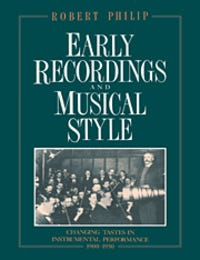
In attempting to explain the change in the performance practices of orchestras musicologists have pointed to the emergence of the recording technology itself (see Robert Philip, Early Recordings and Musical Style, 1992).
The things that work in a live performance do not translate as well in a recording.
The argument made is that recording technology changed the way in which musicians started to approach musical performance.
This would well explain the marked differences in the recordings of tango orchestras between the 1920’s and the 30’s onwards.
However, Argentinian musicologist Enrique Binda points to additional factors.
In his article “Artesanos versus obreros” (2019) he argues that prior to 1930 tango orchestras were still sort of a family business in which there was a significant amount of contribution from each musician who was an artisan.
It would be equivalent to a jazz ensemble such as the Miles Davis quintet, or a rock group.
Binda argues that after 1930 the orchestras became bigger and the importance of the leader, arranger and composer became elevated.
The role of the individual musicians was now merely to execute the plan laid out by the leader and arranger.
Fidelity to the plan was more important than individual expression and engagement.
There was less involvement by the musicians in the composition of the music and they were mainly skilled at reproduction.
It might be added that the style of performance changed also in that the orchestras aimed for a bigger and more energetic sound by reducing the space allowed to individual instruments and instead playing in a more symphonic way, producing a sort of ‘wall of sound’ effect.
By contrast, the 1920s orchestras exhibit greater variation in the interplay between instruments, more opening up of space, and less overlap between them, so that the music exhibits greater variety, individual contribution and improvisation.
What does that mean for us today?
It does not mean that EdO music is not good music, and that we shouldn’t dance to it.
It also does not mean that the 1920s music is not dancing music.
It does, however, put into a different light D’Arienzo’s putative claim that he brought back dancing music, and also the idea that there is a strong distinction between tango for dancing vs. for listening.
Many people talk about connection, and the idea that tango is about feeling.
It is not always clear what we should be connecting to or what we should be feeling.
If we recognise that music is the language of emotion then the question is what is the vehicle of emotion in music and here the answer is that in Western music the vehicle of emotion or feeling is the melody, or more exactly the movement created through the main melody and the accompanying melodies in the low and middle ‘voices’.
In Western music the system of tones enables the creation of the sense of forward movement.
We understand music in terms of spatial metaphors.
Music moves forward, it moves fast or slow, it moves up or down, it starts from a certain place and returns to a place, it is big or small.
Moreover, harmony means that there are several musical lines interacting to give the overall effect.
While an orchestra with a larger number of instruments can create a bigger effect, with more energy and a stronger rhythm, playing fast in a tight formation, this can have some disadvantages.
First, it will be more difficult to understand what is going on because individual melodic lines will be less distinct.
A ‘wall of sound’ effect reduces our ability to follow the melody, which is what we need to connect to the movement of the music.
Second, it will mean that there will be less contribution of the individual musicians and interaction between the instruments, to create interesting and emotionally compelling melodies.
It provides us with a sense of forward movement but there is less to see along the way to sustain interest.
There is less variation, embellishement, individual contribution and improvisation.
It’s a more homogenised sort of sound.
To see this you can compare the same composition, for example, El Flete recorded by Orquesta Tipica Victor in 1930, and by D’Arienzo’s orchestra only six years later.
This difference is not confined only to the more rhythmic style of tango music.
For example, Pugliese’s orchestra is considered to be in the more romantic and melodic style. I
So it’s interesting to compare Pugliese’s 1948 to De Caro’s 1928 recording of Boedo.
Although Pugliese’s performance sounds great and has variety and interest, it’s still more limited in range than De Caro’s.
Why is this important?
Should we be dancing to the 1920s tangos?
Whether or not we want to dance to the earlier recordings, my argument is that the bigger sound of the EdO recordings tends to reduce their ‘listenability’ and that this represents a real problem and a barrier to learning and connecting to tango.
In order to dance we need to listen, and if we only ever listen when we are dancing then that means that the music is probably not engaging us emotionally.
To engage emotionally to music we need an emotionally engaging performance, and we also need a reproduction that provides us with a clear enough image of the music coming out of the speakers in the listening room.
If the performance is rhythmic and energetic but lacks melodic interest and variety then we will stop listening to it and it becomes a mere musical background to our movement.
Also, the 1920’s recordings do require a better listening set-up and won’t sound very good in resonant studio spaces played from lo-fi audio systems.
The resonant space and the electronics of the audio equipment will introduce subtle forms of distortion and we lose interest and emotional engagement.
A basic understanding of audio set up and room acoustics can go a long way and will be rewarding in terms of providing for emotional engagement and connection.
Additional resources: Historical Recordings from the Beginning of the 20th Century